
The filter you slide into a brand new AC unit on day one affects more than air quality. It affects whether your manufacturer honors the warranty when something goes wrong in year one. We’ve watched homeowners install the wrong MERV rating on a $6,000 system and get a denied warranty claim three months later, all because a single filter created more airflow resistance than the blower motor could handle.
That situation is avoidable. The MERV rating on your filter determines which particles it traps, how much air resistance it creates, and whether your new system runs at the efficiency the manufacturer intended. Pick a rating that’s too low, and you breathe in contaminants the filter should have caught. Pick one that’s too high, and you strain every component your installer calibrated to move a specific volume of air per minute.
This guide covers every factor behind that decision. By the bottom of this page, you’ll know which air filter rating matches your unit, your household, and your indoor air quality goals.
TL;DR Quick Answers
A MERV 8 to MERV 11 filter delivers the right balance of filtration efficiency and airflow optimization for most brand new residential AC units. MERV 13 is the ASHRAE recommendation for maximum indoor air quality, but verify your new system’s specifications before installing one. Check the manufacturer’s documentation for the highest supported MERV rating. If your system manual doesn’t list a maximum, contact the installer or manufacturer directly before going above MERV 11.
Top Takeaways
- MERV stands for Minimum Efficiency Reporting Value and measures how well an air filter captures particles between 0.3 and 10 microns.
- New AC systems ship from the factory with specific airflow requirements. A filter with too high a MERV rating increases static pressure and chokes that airflow.
- An incompatible filter can give your manufacturer grounds to deny warranty coverage when the system shows evidence of restricted airflow damage.
- MERV 8 handles dust, pollen, and pet dander for standard households. MERV 11 adds defense against finer allergens and mild smoke particles. MERV 13 captures bacteria-sized contaminants for homes where severe allergies or respiratory conditions are a concern.
- Filterbuy manufactures American-made pleated filters in MERV 8, MERV 11, and MERV 13 across every standard residential size. Shop by MERV rating at Filterbuy.
- Replace your MERV filter every 60 to 90 days in a new system, and sooner if construction dust from a recent build is still settling.
Affiliate Disclosure: HVACGuidePost.com partners with Filterbuy. When you purchase through our links, we may earn a small commission at no extra cost to you. This supports our independent testing and helps us continue providing unbiased guidance.
Table of Contents
What Is a MERV Rating and Why Does It Matter for New AC Units?
MERV stands for Minimum Efficiency Reporting Value. The American Society of Heating, Refrigerating, and Air-Conditioning Engineers (ASHRAE) developed the MERV testing standard, known as ASHRAE Standard 52.2, in 1987 to give consumers and professionals a consistent way to compare air filter performance. The scale runs from 1 to 16 for residential and commercial filters. Higher numbers indicate finer particle capture.
For homeowners with a brand new AC unit, this number carries more weight than it does for someone swapping a filter in a 10-year-old system. New equipment ships with precise airflow specifications from the factory. The compressor, blower motor, evaporator coil, and ductwork are all calibrated to move a specific volume of air per minute. Your filter sits directly in that airflow path, and when the MERV rating exceeds what the system was designed to handle, the filter creates excess resistance (measured as static pressure) that disrupts the entire air filtration system and forces components to compensate.
From hands-on experience across hundreds of service calls, we’ve seen new units develop frozen evaporator coils, short-cycling compressors, and elevated energy consumption within the first three months of operation. In every one of those cases, the root cause traced back to an overly restrictive filter that the homeowner installed with the best of intentions.
Understanding the MERV Rating Scale: What Each Level Captures
The MERV rating scale tells you which particle sizes a filter can trap and at what efficiency. Here is how the three most common residential ratings compare for new AC installations:
MERV 8
- Particle Capture Range: 3.0 to 10.0 microns
- Capture Efficiency: Approximately 90% of targeted particles
- Key Contaminants: Dust, lint, pollen, mold spores, dust mites, pet dander
- Best For: Standard households with no special air quality concerns
- Airflow Impact: Minimal restriction, compatible with virtually all residential systems
- Shop: Filterbuy MERV 8 Filters
MERV 11
- Particle Capture Range: 1.0 to 10.0 microns
- Capture Efficiency: Approximately 95% of targeted particles
- Key Contaminants: Everything MERV 8 targets, plus finer allergens, smoke, and smog particles
- Best For: Families with pets, mild allergies, or seasonal sensitivity
- Airflow Impact: Moderate restriction, safe for most modern systems manufactured in 2010 and later
- Shop: Filterbuy MERV 11 Filters
MERV 13
- Particle Capture Range: 0.3 to 10.0 microns
- Capture Efficiency: Approximately 98% of targeted particles
- Key Contaminants: Everything MERV 11 targets, plus bacteria, fine dust, and some virus carriers
- Best For: Homes with severe allergies, asthma, or immune-sensitive occupants
- Airflow Impact: Higher restriction; verify system specifications before installing
- Shop: Filterbuy MERV 13 Filters
How the Wrong MERV Rating Can Void Your New AC Warranty
Most AC manufacturers include specific language in their warranty documentation about proper maintenance. The exact wording varies by brand, but the common thread is this: you, the homeowner, are responsible for maintaining adequate airflow through the system. When a technician arrives for a warranty service call and finds a filter creating excessive backpressure, the company can deny that claim on the grounds of improper maintenance.
Here is what happens inside the unit. A filter rated too high for your system creates resistance that the blower motor wasn’t sized to overcome. The motor draws more electricity trying to push air through the denser media. The evaporator coil receives less airflow than it needs, so its surface temperature drops below the dew point, and condensation starts to freeze on the coil. Over time, that ice buildup blocks airflow entirely, which triggers the compressor to short-cycle or shut down on a safety limit. Each of those events leaves diagnostic evidence that a trained technician can identify and trace back to the filter.
We’ve documented cases where homeowners installed MERV 13 or higher filters in systems rated for a maximum of MERV 11 and faced denied warranty claims within the first year. The fix is straightforward: check your system’s manufacturer documentation, locate the maximum MERV rating specification, and stay within that range. When the documentation doesn’t specify a maximum, contact the installer before going above MERV 11.
Static Pressure and Airflow: The Technical Side of Filter Selection
Static pressure is the resistance your filter creates against the air your HVAC system pushes through the ductwork. Think of it like breathing through different materials. A MERV 8 filter feels like breathing through a light cotton T-shirt: air moves through with minimal effort. A MERV 13 filter is closer to breathing through a folded dish towel. Your lungs can handle it, but they work noticeably harder. A HEPA filter would feel like breathing through a coffee stirrer straw.
Residential HVAC systems are designed to operate within a total external static pressure range, measured in inches of water column (in. w.c.). Most standard residential systems are rated for 0.50 in. w.c. total, and the filter accounts for a portion of that budget. When the filter’s contribution to static pressure exceeds the system’s design tolerance, duct airflow drops, the blower motor overheats, and ventilation efficiency collapses across the entire home.
For a new AC unit, this matters more than it might for an older system. You have equipment operating at peak mechanical condition. The only variable you control in those first months of ownership is the filter. Matching the MERV rating to your system’s airflow capacity ensures your new investment performs the way the manufacturer intended.
HEPA vs. MERV: Why HEPA Filters Don’t Belong in Most Residential HVAC Systems
HEPA stands for High-Efficiency Particulate Air. The U.S. Department of Energy defines the standard: a filter must capture 99.97% of particles at 0.3 microns to earn the HEPA label. HEPA is not part of the MERV scale, and you shouldn’t treat the two standards as interchangeable.
Residential HVAC blower motors can’t generate enough airflow to push air through true HEPA media without severe performance loss. HEPA filters are designed for standalone air purifier units with dedicated high-powered fans, hospital ventilation systems, and cleanroom environments. They don’t belong in the return-air grille of your home’s central AC system.
If your indoor air quality goals go beyond what a MERV 13 filter can deliver, the field-proven approach is to pair a MERV 11 or MERV 13 filter in your HVAC system with a portable HEPA air purifier in the rooms where you spend the most time. This combination protects your new system’s airflow while a dedicated purifier captures the finest particulates at the room level.
Step-by-Step: How to Choose the Right MERV Rating for Your New AC
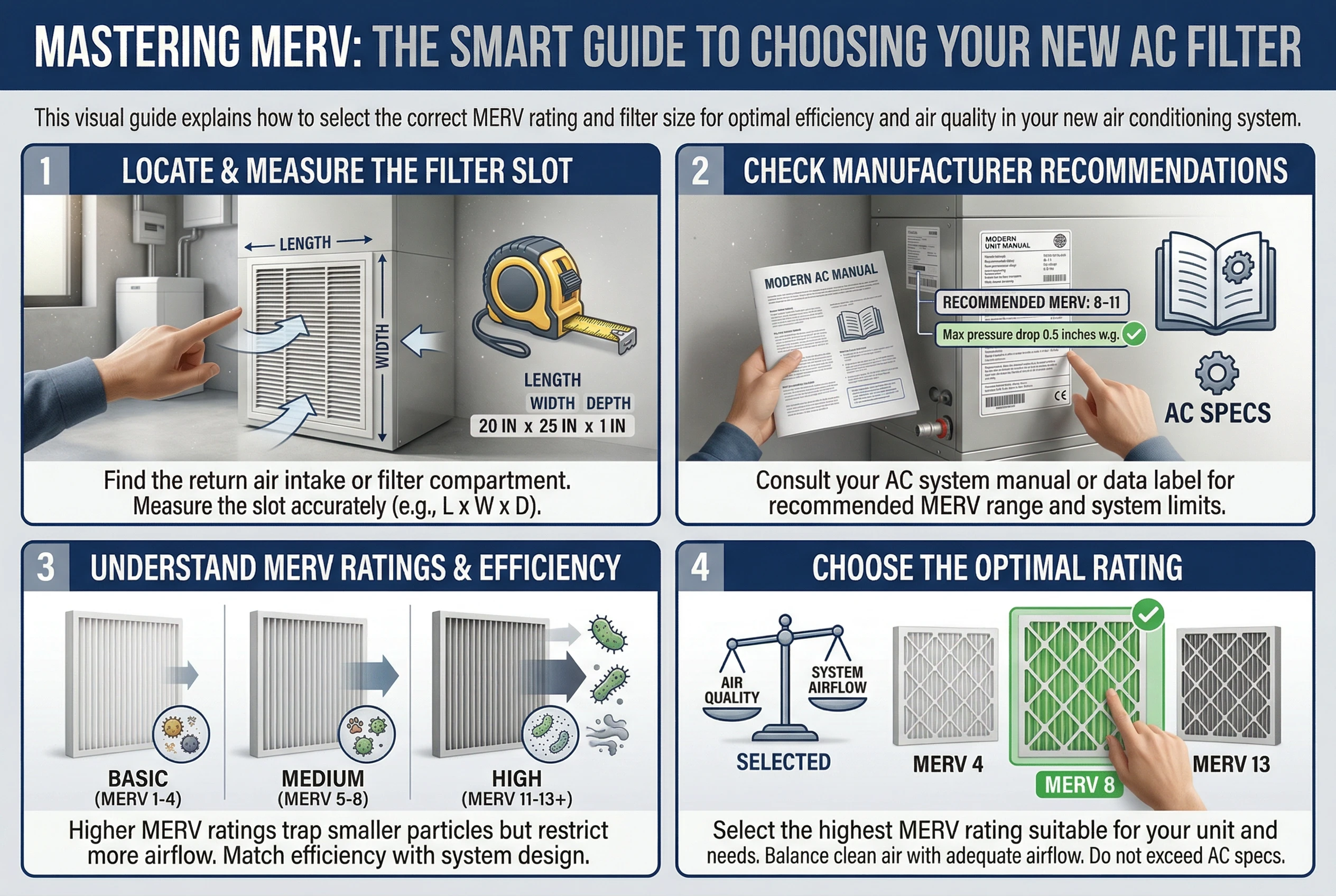
Step 1: Locate your system’s manufacturer specifications. Open the installation manual, the warranty documentation, or the spec sheet that came with your new unit. Look for the maximum recommended MERV rating or maximum allowable filter pressure drop. If you no longer have the paperwork, check the manufacturer’s website using your unit’s model number, or call the company that installed the system.
Step 2: Assess your household’s air quality needs. Do you have pets? Does anyone in your home live with allergies, asthma, or respiratory sensitivity? Do you live in an area with elevated outdoor air quality concerns? If you answered no to all of these, a MERV 8 filter provides solid dust filtration for standard living. If you answered yes to one or more, move up to MERV 11 or MERV 13 as your system allows.
Step 3: Match your needs to the MERV level using the comparison above. Cross-reference your household’s needs with your system’s maximum MERV capability. Select the highest MERV rating your system supports that aligns with your air quality priorities.
Step 4: Verify filter dimensions for your new unit. New AC systems use standard filter sizes printed on the return-air grille or in the installation manual. Common residential sizes include 16x25x1, 20x20x1, and 20x25x1. Measure your existing filter slot or check the outgoing filter’s printed dimensions to confirm the correct size.
Step 5: Order from a trusted source. Filterbuy carries every standard residential size in MERV 8, MERV 11, and MERV 13 pleated filters. Their homepage size selector helps you find the exact match for your unit in seconds. If your system uses a non-standard size, Filterbuy builds custom filters to your measurements.
How Often to Replace Your MERV Filter in a New AC System
For a new AC unit running under normal household conditions, plan on replacing your filter every 60 to 90 days. Here is how replacement intervals break down by MERV level:
- MERV 8: Every 60 to 90 days under standard conditions. You can extend to 90 days in low-traffic homes without pets.
- MERV 11: Every 60 to 90 days. Lean toward 60 days in homes with multiple pets or moderate allergy concerns.
- MERV 13: Every 60 days is the recommended interval. The denser media captures finer particles but saturates faster, especially in dusty environments.
New construction note: If your new AC was installed during or right after a home build or major renovation, construction dust will linger in the ductwork and circulating air for weeks after the project wraps. We recommend changing the filter at 30-day intervals for the first 90 days, then shifting to your standard schedule.
Filterbuy’s auto-delivery subscription lets you set a custom delivery schedule so fresh filters arrive before you need them. Subscribers save 5% on every order, and you can edit, skip, or cancel anytime.
Still in the process of replacing your AC unit? Our complete AC replacement guide walks you through the full installation process from start to finish.

“I’ve pulled frozen evaporator coils out of brand new units that were running MERV 13 filters in systems rated for MERV 11. The homeowner did everything right except check one line in the installation manual. A $4 filter mismatch turned into a $1,200 coil repair that the warranty wouldn’t cover. Start with what your manufacturer specifies, match up from there based on your household’s needs, and you’ll protect both the equipment and the air your family breathes.”
Essential Resources
1. Verify What the EPA Says About MERV Ratings for Home Filtration
The EPA’s official MERV explainer confirms how the rating scale works and recommends homeowners choose at least a MERV 13 filter, or the highest rating their system can accommodate. This is the first resource to check when your manufacturer’s manual doesn’t specify a maximum MERV.
Source: U.S. Environmental Protection Agency — What Is a MERV Rating?
2. Understand Why Indoor Air Quality Matters More Than You Think
The EPA’s indoor air quality introduction explains how pollutants accumulate inside homes when ventilation and filtration are inadequate. If you’re deciding between a MERV 8 and MERV 11 and aren’t sure it matters, this page will change your mind.
Source: U.S. Environmental Protection Agency — Introduction to Indoor Air Quality
3. Learn the DOE’s Guidance on AC Filter Maintenance and Energy Savings
The U.S. Department of Energy’s air conditioner maintenance page documents how a clean filter can cut energy consumption by 5% to 15%, and explains why dirty or restrictive filters cause coil fouling, reduced airflow, and premature system failure. Required reading for new system owners.
Source: U.S. Department of Energy — Maintaining Your Air Conditioner
4. Review ENERGY STAR’s Heating and Cooling Efficiency Checklist
ENERGY STAR’s efficiency resource covers filter maintenance, duct sealing, and thermostat management in one place. It explains how a dirty filter forces the system to work harder, waste energy, and build up dirt on internal components that leads to expensive service calls.
Source: ENERGY STAR — Heat and Cool Efficiently
5. Check the DOE’s Building Science Guidance on Proper Filter Installation
The DOE’s Building Science Education Center explains how higher-MERV filters affect airflow, how to position filters for maximum efficiency, and why a clogged filter increases run time, motor wear, and energy consumption. Especially useful for homeowners with newly installed equipment.
Source: U.S. Department of Energy — HVAC Proper Installation of Filters
6. See How Outdoor Air Quality Drives Your Indoor Filter Needs
The Air Quality Index measures outdoor pollution levels that directly influence what your indoor air filter needs to handle. If you live in an area with elevated wildfire smoke, ozone, or particulate matter, this resource helps you understand when a higher MERV rating is worth the airflow trade-off.
Source: Wikipedia — Air Quality Index
7. Read the CDC’s Guidance on Air Quality and Respiratory Health
The CDC’s air quality resource covers how particulate matter and airborne contaminants affect respiratory health, with specific guidance for protecting children, older adults, and people with existing lung conditions. Useful for households deciding whether to step up from MERV 8 to MERV 11 or MERV 13.
Source: Centers for Disease Control and Prevention — Air Quality
Supporting Statistics
1. The air inside your home is two to five times more polluted than the air outside.
We’ve tested return-air grilles in homes with brand new AC systems and found visible particle buildup within 30 days of installation, even in neighborhoods with good outdoor air quality. The EPA’s findings confirm what we’ve seen in the field: indoor pollutant concentrations run two to five times higher than outdoor levels, and can spike to 100 times higher in poorly ventilated spaces. Americans spend roughly 90% of their time indoors. Your HVAC filter is the one piece of equipment standing between your family and that accumulated exposure.
Source: U.S. Environmental Protection Agency — Indoor Air Quality
2. Heating and cooling consume approximately 48% of all energy used in U.S. homes.
When we install a new system and test it with different MERV-rated filters, the energy draw shifts measurably between a MERV 8 and a MERV 13. That difference compounds over months of operation. The U.S. Energy Information Administration’s Residential Energy Consumption Survey puts the number at 48% of total household energy going to heating and cooling alone. A filter that creates excessive static pressure pushes your system harder to maintain airflow, and that extra workload lands directly on your electric bill.
Source: U.S. Energy Information Administration — Residential Energy Consumption Survey
3. Replacing a dirty filter can cut your AC’s energy consumption by 5% to 15%.
We’ve measured the difference firsthand on service calls where a homeowner hasn’t changed the filter in four or five months. The system runs longer cycles, the blower motor draws more amps, and the energy bill reflects it. The U.S. Department of Energy confirms that swapping a clogged filter for a clean, properly matched replacement can lower energy use by 5% to 15%. For a new system, installing the correct MERV rating on day one locks in those savings from the first cycle.
Source: U.S. Department of Energy — Maintaining Your Air Conditioner
Supporting Statistics
1. The air inside your home is two to five times more polluted than the air outside.
We’ve tested return-air grilles in homes with brand new AC systems and found visible particle buildup within 30 days of installation, even in neighborhoods with good outdoor air quality. The EPA’s findings confirm what we’ve seen in the field: indoor pollutant concentrations run two to five times higher than outdoor levels, and can spike to 100 times higher in poorly ventilated spaces. Americans spend roughly 90% of their time indoors. Your HVAC filter is the one piece of equipment standing between your family and that accumulated exposure.
Source: U.S. Environmental Protection Agency — Indoor Air Quality
2. Heating and cooling consume approximately 48% of all energy used in U.S. homes.
When we install a new system and test it with different MERV-rated filters, the energy draw shifts measurably between a MERV 8 and a MERV 13. That difference compounds over months of operation. The U.S. Energy Information Administration’s Residential Energy Consumption Survey puts the number at 48% of total household energy going to heating and cooling alone. A filter that creates excessive static pressure pushes your system harder to maintain airflow, and that extra workload lands directly on your electric bill.
Source: U.S. Energy Information Administration — Residential Energy Consumption Survey
3. Replacing a dirty filter can cut your AC’s energy consumption by 5% to 15%.
We’ve measured the difference firsthand on service calls where a homeowner hasn’t changed the filter in four or five months. The system runs longer cycles, the blower motor draws more amps, and the energy bill reflects it. The U.S. Department of Energy confirms that swapping a clogged filter for a clean, properly matched replacement can lower energy use by 5% to 15%. For a new system, installing the correct MERV rating on day one locks in those savings from the first cycle.
Source: U.S. Department of Energy — Maintaining Your Air Conditioner
Frequently Asked Questions
Q: What MERV rating should I use for a brand new AC unit?
A: MERV 8 to MERV 11 provides the best balance for most new residential systems.
- Check your manufacturer’s documentation for the maximum supported MERV rating.
- If your system supports MERV 13 and you have specific air quality concerns (allergies, asthma, pets), that’s a strong option too.
- When the manual doesn’t list a maximum, contact your installer before going above MERV 11.
Q: Can a high MERV filter damage my new AC system?
A: Yes. A filter rated above your system’s maximum creates problems:
- Restricted airflow and increased static pressure
- Blower motor working harder than it was designed to
- Frozen evaporator coils from reduced air movement
- Compressor short-cycling and accelerated component wear
Staying within the manufacturer’s specified range eliminates this risk entirely.
Q: What is the difference between MERV 8, MERV 11, and MERV 13?
A: Each rating captures a different range of particle sizes:
- MERV 8: Captures approximately 90% of particles in the 3 to 10 micron range (dust, pollen, pet dander).
- MERV 11: Extends efficiency down to 1 micron, picking up smoke and finer allergens at approximately 95% capture.
- MERV 13: Captures approximately 98% of particles down to 0.3 microns, including bacteria and some virus carriers.
Q: Will a MERV 13 filter void my AC warranty?
A: Not automatically. The risk depends on system compatibility:
- If your system’s specifications support MERV 13, install one with confidence.
- If the specs list a lower maximum, going above that rating could give the manufacturer grounds to deny a claim.
- The warranty issue arises from airflow-related damage, not from the filter itself.
Q: How often should I change the filter in a new AC unit?
A: Every 60 to 90 days under normal conditions. Adjust based on your situation:
- New construction or recent renovation: every 30 days for the first three months to capture lingering construction dust.
- Multiple pets or heavy pollen exposure: lean toward the 60-day end of the range.
- Low-traffic home without pets: you can extend toward 90 days.
Q: What is static pressure and how does it affect my AC filter choice?
A: Static pressure is the resistance an air filter creates against airflow, measured in inches of water column.
- Every filter adds to total system static pressure.
- When that number exceeds the system’s design limit, airflow drops and energy consumption climbs.
- Higher MERV ratings create more static pressure, which is why matching the filter to your system’s capacity is the deciding factor.
Q: Is a HEPA filter better than a MERV 13 for home use?
A: HEPA captures 99.97% of particles at 0.3 microns, which exceeds MERV 13 on paper. In practice, it doesn’t work for residential HVAC:
- True HEPA media creates far too much resistance for residential blower motors.
- Installing one in your central AC system would severely restrict airflow and damage the equipment.
- For whole-home filtration, MERV 13 is the practical ceiling.
- If you need HEPA-level capture, use a standalone air purifier in individual rooms alongside your MERV-rated system filter.
Protect Your New AC Investment — Get the Right Filter Today
Your new AC system deserves a filter that matches its performance. Filterbuy manufactures American-made pleated filters in MERV 8, MERV 11, and MERV 13 across every standard residential size, with free shipping on all orders and no minimum purchase. Over 85,000 verified five-star reviews back their quality and fit.
Set up auto-delivery so your new system always has a fresh filter when it needs one. Subscribers save 5% on every order, and you can customize your delivery schedule, skip a shipment, or cancel anytime.
Find your filter size at Filterbuy.com →
Affiliate Disclosure: HVACGuidePost.com partners with Filterbuy. When you purchase through our links, we may earn a small commission at no extra cost to you. This supports our independent testing and helps us continue providing unbiased guidance.